 October 24, 2025
In the era of digitalization across industries and social sectors, protection against unauthorized access has become increasingly crucial. Ensuring the confidentiality of internal information helps prevent data leaks that can lead to financial, moral, and reputational losses. A key component of this protection is preventing sniffing — the unauthorized interception of corporate information flows.
Working with information is impossible without well-organized cybersecurity. Protecting data from malicious actors is essential to safeguard valuable information that could otherwise become a source of profit for attackers and losses for you. The theft — or even the threat — of such data undermines the operations of businesses, industrial enterprises, and government organizations.
The effectiveness of protection depends on a comprehensive approach combining organizational, technical, and administrative measures. Among these, preventing sniffing attacks—the interception of valuable network data—is a critical step, as such losses directly translate into financial and operational damage.
What Is a Sniffing Attack
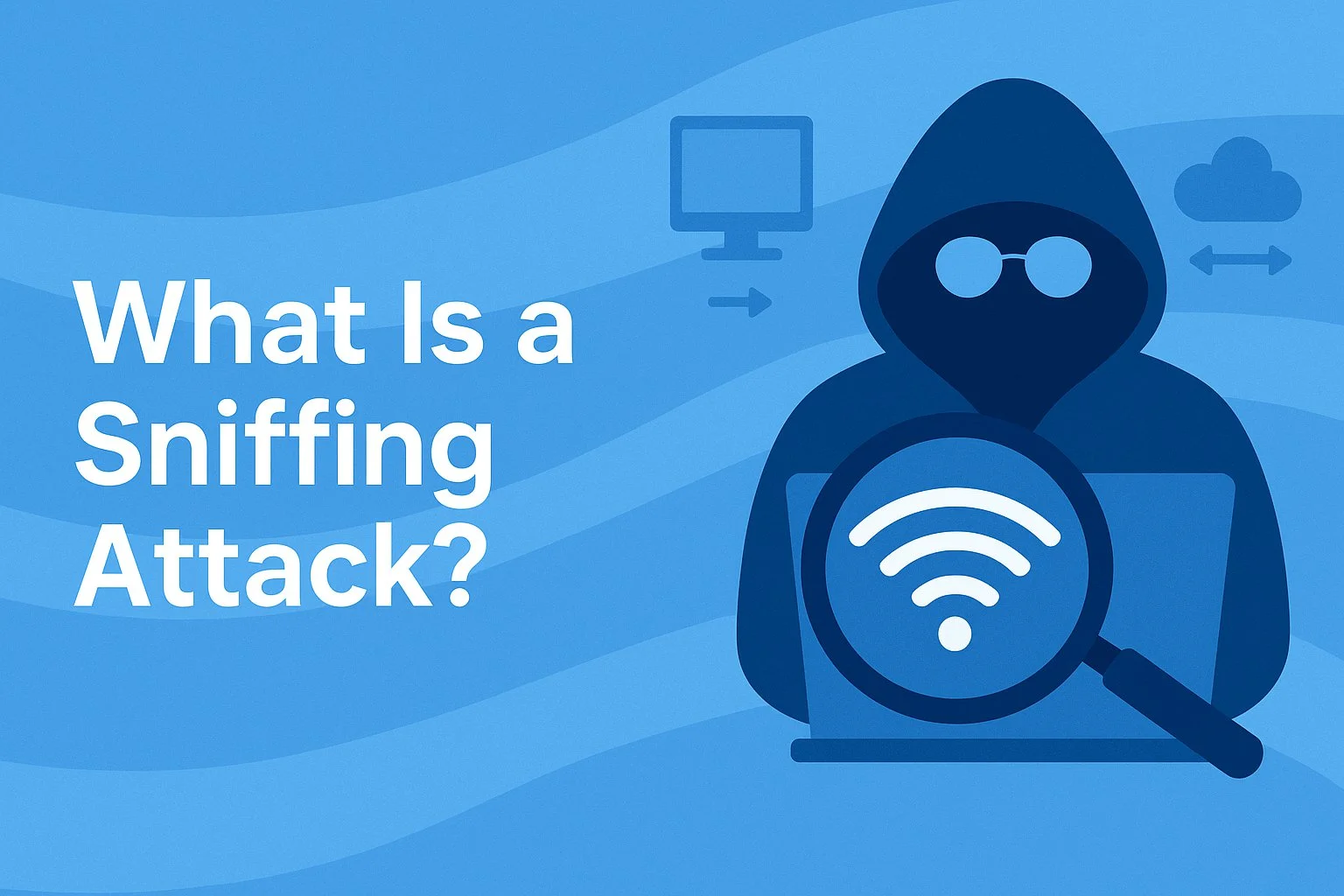
A sniffing attack is a method used by cybercriminals to monitor network traffic in order to collect and analyze transmitted data. The term “sniffing” comes from the English word to sniff, meaning “to smell out” or “to detect.”
The challenge lies in the fact that sniffing itself can be legitimate and useful — it is widely used for network diagnostics, testing, and analysis. However, attackers exploit the same technique for malicious purposes: to steal confidential information and gain unauthorized access to systems and accounts.
The goal of unauthorized sniffing is to extract data valuable to the attacker, including:
- Usernames and passwords, used to access online banking, e-commerce accounts, and websites.
- Bank card numbers and security codes, which can be used to steal funds.
- Private chat messages containing sensitive information — often used for blackmail or extortion.
- Business email correspondence, which may reveal strategic or financial data.
- Router configurations, enabling full access to network traffic.
- DNS traffic between computers and servers, which may contain technical, corporate, or even classified government information.
The result of a successful sniffing attack is financial gain for the attacker and losses for the victim, including monetary damage, reputational harm, loss of market position, and exposure of confidential data or trade secrets.
How Sniffing Works: Technical Mechanism
Sniffing is based on intercepting data from network traffic using sniffers — hardware devices or software suites (applications). They eavesdrop on and analyze packets exchanged between user applications and servers, recording and detailing them. Sniffers work with headers, request bodies, and response status codes, then forward the captured data to the attacker’s destinations.
Sniffing can be:
- Local — directly on the devices (computers) that send and receive traffic. It can be set up via a sniffer proxy and is used to test specific applications.
- Network-wide — by listening to all traffic within a particular network segment, covering the entire network equipment in that segment.
By implementation method it can be:
- Hardware-based — for efficient inspection of flows on particular network segments, involving physical attachment to the network.
- Software-based — collecting all traffic from a network interface.
In addition, interception can be carried out by inserting connections into communication links or by duplicating traffic branches — either programmatically or with hardware — and directing copies to the sniffer.
To legitimate applications and services, interaction with sniffers appears like normal communication with servers. Such interception is possible with unencrypted connections (HTTP, FTP, SMTP, POP3), where information is transmitted as plaintext.
Classification of Network Attacks: Where Sniffing Fits In
There are many types of network attacks, just as there are many varieties of networks that these attacks adapt to.
Types
Common types in classifications of network attacks include:
- packet sniffers;
- IP or ARP spoofing, where attackers impersonate other hosts and intercept all passing traffic;
- denial-of-service attacks;
- password attacks;
- Man-in-the-Middle (MITM) attacks;
- application-layer attacks;
- network reconnaissance;
- abuse of trust;
- port forwarding abuse;
- unauthorized access;
- viruses and Trojan-type applications.
Among this array of attacks, sniffing is a passive network attack — it does not affect system operation but breaches privacy policies. Sniffing is typically possible only within local network segments or at specific points of the network. It is used to study traffic data in order to gain access to a network or particular systems and then participate in their interactions.
Sniffing as a Core Tool for MITM
MITM (Man-in-the-Middle) attacks are more sophisticated — they alter communications between participants in a network. In such attacks, sniffing is used to survey networks and extract confidential data (passwords, numbers, identifiers), which is then manipulated and used under the identity of the compromised party.
Malicious intermediaries typically:
- route request flows through their own devices;
- capture information from unencrypted protocols and manipulate it — modifying web-page content, replacing files, or injecting malicious code;
- after tampering, forward the traffic to the intended recipients, who do not notice the interference or substitution.
Attackers commonly use sniffing tools such as:
- Intercepter-NG — for capturing website logins and passwords and recovering transmitted files;
- Bettercap — for intercepting and processing network traffic with automated scenarios via plugins.
Thus, sniffing can be a component of complex, advanced attacks that combine various techniques, hardware, and software.
Where Sniffing Attacks Are Most Commonly Used
The most vulnerable targets are easily accessible public Wi-Fi networks, since they are often poorly protected or not protected at all.
A common mass environment for sniffing attacks is corporate networks, which offer many potential injection points — including negligent or malicious employees.
Even well-protected organizations attract special interest from attackers: banks and payment systems, travel agencies and marketplaces, insurance and logistics companies. These entities are valuable to malicious actors because they hold large volumes of personal and organizational data directly related to money and material resources.
Who Is at Risk
First and foremost, users who connect to public Wi-Fi in airports, hotels, cafés, entertainment venues, and other public places are at high risk of being compromised.
Any organization that processes payment details or other sensitive information on its websites without robust protection risks losing confidential data — and so do their customers, who may suffer financial theft from their accounts.
Corporations, large companies, industry agencies (especially law-enforcement bodies), and government institutions are also at risk. These organizations have extensive local networks and many potential points for unauthorized sniffing intrusions.
The locations and entities listed above, regardless of their level of protection, are all potential targets for sniffing.
How to Detect That You’re Being Attacked
For ordinary users, detecting the presence of sniffers can be difficult. However, it can be done through systematic monitoring and analysis:
- Monitor network activity. Use traffic monitoring tools to detect suspicious or abnormal behavior in data flows.
- Use network and antivirus scanners. These tools help identify anomalies and distortions in normal traffic patterns.
- Check ARP tables. If you notice duplicate IP addresses or unfamiliar MAC addresses appearing in your ARP table, it’s a strong indication of a sniffing attack.
- Control traffic with firewalls. Firewalls can help detect and block unusual or unauthorized traffic patterns.
Once a sniffing attack or packet interception is detected, it’s crucial to isolate affected devices and network segments and reinforce data protection measures to prevent further compromise.
How to Protect Yourself from a Sniffing Attack
Ideally, both systems and users should be protected by network administrators. However, for individual protection, the following measures are strongly recommended:
- Avoid open and public networks without a VPN. Always use a VPN when connecting to public Wi-Fi. Disable automatic Wi-Fi connections. When browsing, check for HTTPS (the padlock icon) to ensure a secure connection.
- Avoid suspicious websites and unverified links. Never enter personal data or passwords on such sites.
- Keep your systems up to date. Regularly update antivirus software, drivers, operating systems, and other applications.
- Use VPS servers for continuous, large-scale work that requires both autonomy and security.
- Install reliable antivirus, anti-spyware, and firewall tools for real-time detection and monitoring.
- Enable two-factor authentication and use complex, unique passwords — change them at least twice a year.
For administrators, business leaders, and IT departments in large organizations or corporations, stronger security measures should be enforced:
- Use secure HTTPS protocols for web traffic. For full protection, deploy VPN servers and virtual private networks (VPNs) with encrypted tunnels between them.
- Segment networks into isolated VLANs and apply multi-layer firewalls while continuously monitoring traffic.
- Implement modern IDS/IPS systems (Intrusion Detection and Prevention Systems) to automatically detect and block intrusions or suspicious activity.
- Verify SSL/TLS certificates regularly to prevent spoofing or man-in-the-middle attacks.
For ongoing protection, it is crucial to stay updated on cybersecurity innovations and integrate new security measures into your infrastructure as they emerge.
Legality and Ethics
The legal framework governing information processing — including sniffing — is regulated by the state under Federal Laws No. 152-FZ (prohibition on collecting personal data without consent), No. 149-FZ (regulation of open access to information), No. 187-FZ (prohibition of unauthorized access), and the Code of Administrative Offences of the Russian Federation (KoAP RF).
From an ethical standpoint, anonymity and confidentiality must be respected when collecting data. Legitimate use of sniffing tools is permitted in specific, controlled cases only:
- Analyzing traffic on your own networks. Diagnosing and testing system issues.
- Detecting intrusions via pentests, when authorized by the owner — performing system audits that simulate malicious attacks.
- In laboratory training contexts.
- At the request of law-enforcement agencies.
Cases where interception constitutes a criminal offense under Federal Law No. 187-FZ and articles of the Criminal Code of the Russian Federation include:
- Unauthorized access to other people’s computer systems and networks.
- Deployment of malicious software.
- Copying, modifying, blocking, or destroying information during sniffing activities.
You can face legal consequences even for accidental interceptions of data. Therefore, it is recommended to use sniffing tools only on networks you own or explicitly for authorized testing.
Best Tools for Network Traffic Analysis
There are many programs for analyzing network traffic—free and paid, general-purpose and task-specific.
Free, open-source tools:
- Wireshark — deep traffic analysis with powerful filters and support for many protocols.
- ntopng — classifies flows with statistics by IP addresses, geolocations, and protocols; detects suspicious activity.
- Zeek — analyzes the network and logs all observed activity.
- Suricata — real-time intrusion detection and prevention (IDS/IPS).
Paid security tools:
- SolarWinds NPM — automatic device and traffic discovery with analysis and charts for enterprise networks.
- PRTG Network Monitor — monitors devices, servers, and applications; uses diverse sensors and alerts on issues.
- Datadog Network Performance Monitoring — cloud-based deep analysis with flow visualization; integrates with automation systems.
Network and system administrators also use these tools along with Zabbix (free) — it monitors hundreds of thousands of network devices, servers, hardware, and operating systems.
Free tools for learning and hands-on practice:
- Wireshark — captures and analyzes traffic with filters; supports up to ~2,000 protocols.
- tcpdump — packet capture and automation for server workflows.
- NetworkMiner — network forensics; extracts files from captured traffic.
- Xplico — protocol analysis via a web interface with automation capabilities.
Paid tools for training and practical use:
- PRTG Network Monitor — convenient visualization.
- SolarWinds NPM — monitors high-performance networks and provides extensive analytics.
- Scrutinizer — enterprise-grade flow analysis with advanced reporting.
- Cisco AI Network Analytics — detects anomalies and predicts issues.
Always remember: misusing traffic analyzers can lead to legal liability.
Frequently Asked Questions
Is a sniffer a virus?
No, standard sniffers (both hardware and software) are passive monitoring tools that observe traffic without altering it. However, attackers may use them in combination with malware or for malicious purposes.
Can sniffers intercept messengers?
Modern messaging apps have strong end-to-end encryption, making them resistant to sniffing. However, attackers may still target users through compromised access points or unsecured networks.
Does a VPN provide complete protection?
A VPN encrypts your data and protects it during transmission, but it does not guarantee full anonymity. Other tracking methods—like browser fingerprints or compromised devices—can still expose information.
What should I do if I’ve already been attacked?
If you notice slowdowns, strange activity, or anomalies in your ARP tables, take immediate action. Disconnect from the network. Update all software and security tools. Enable encryption where possible. Avoid reconnecting to public Wi-Fi networks. Use password-protected or VPN-secured connections. Check that all network protocols in use are secure (HTTPS, SSH, SFTP, etc.).
Conclusion
Sniffing attacks are not among the most sophisticated hacking techniques, but they remain one of the most common and dangerous due to their stealth. Fortunately, protecting yourself from them is relatively simple: follow best practices, avoid open networks, and use secure, encrypted connections.
Use network analysis tools only in controlled, private environments, and strictly for testing, learning, or authorized audits. In all other cases, unauthorized traffic interception can lead to serious legal consequences.