 August 10, 2026
Residential proxies have become an important tool for traffic arbitrage specialists. They help professionals work with advertising platforms, analyze offers, test advertising campaigns, and manage multiple accounts while maintaining a stable connection.
If you are planning to buy residential proxies for traffic arbitrage, it is important to understand what tasks they solve and why standard data-center IPs may not always be sufficient.
What Are Residential Proxies?
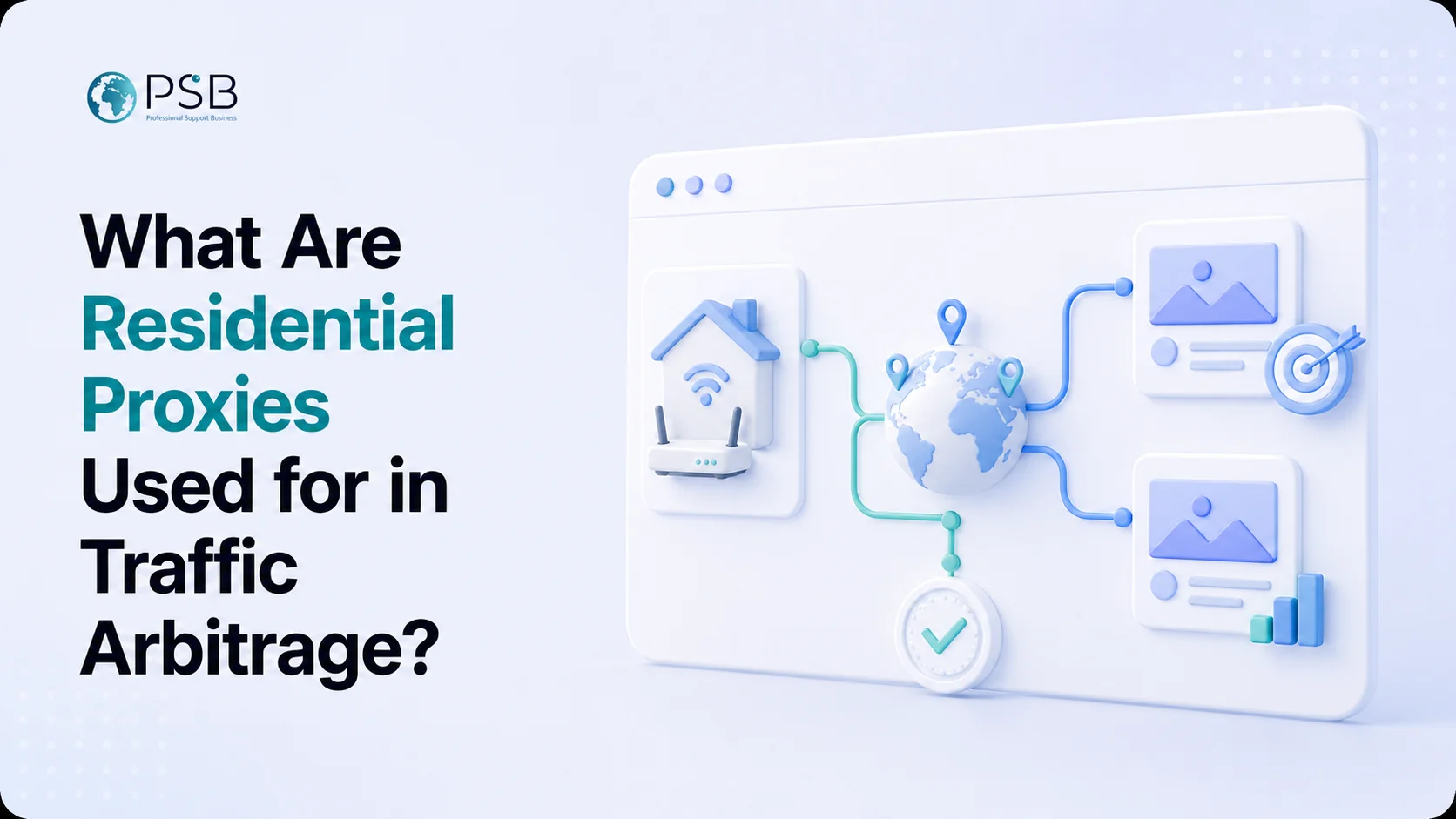
A residential proxy provides an IP address associated with a real residential Internet connection. From a website's perspective, the request looks like it comes from an ordinary user in a specific location.
Unlike data-center proxies, residential IPs generally look more natural to anti-fraud systems and advertising platforms. This is especially important when working with geo-targeted advertising and multiple accounts.
The main advantage is the ability to choose an IP from a specific country, region, or city and change the address according to your needs.
Why Are Residential Proxies Needed in Traffic Arbitrage?
1. Testing Advertising in Different Countries
Traffic arbitrage specialists often launch advertising campaigns in several GEOs at the same time. It is important to check how ads, landing pages, and offers appear to users from different countries.
A residential proxy allows you to connect through an IP address from the required region and view content according to the corresponding geolocation.
For example, an advertising campaign may be displayed differently to users from Germany, the United States, France, or the United Kingdom. Proxies make it possible to check these differences without physically being in each country.
2. Working with Multiple Advertising Accounts
When scaling an arbitrage campaign, a specialist may need several working accounts. Using the same IP address for a large number of profiles can create additional risks from the perspective of platform security systems.
Assigning separate IPs to different workflows helps separate sessions and organize operations more effectively.
However, a proxy does not guarantee that accounts will never be blocked. Account quality, compliance with advertising platform rules, browser settings, and user behavior are also important.
3. Competitor Analysis
For traffic arbitrage, it is important to understand which advertising strategies competitors use: what ads they run, which landing pages they promote, and which GEOs they target.
Residential proxies make it possible to collect publicly available information from different regions and obtain results that more closely correspond to local users.
This can help analyze the market and find new ideas for advertising campaigns.
4. Checking Geo-Targeting
One of the common tasks for an arbitrage specialist is making sure that an advertising platform correctly identifies the user's location.
Proxies with IP addresses from a specific country or city allow you to test:
- advertising display;
- regional landing pages;
- redirects;
- currency and language settings;
- offer availability;
- geo-targeting performance.
This type of testing is especially useful before launching a large-scale advertising campaign.
Why Choose Residential Instead of Data-Center Proxies?
Data-center proxies are known for their high speed and are often cheaper. However, their IP addresses belong to server networks and can be easier for automated systems to identify.
Residential proxies use IP addresses associated with Internet service providers and residential connections. This makes them suitable for tasks where a more natural network connection is important.
For traffic arbitrage, the best option depends on the specific task. If your priorities include geo-targeting, accessing local content, and testing advertising campaigns, residential IPs can often be a more suitable solution.
How to Choose Proxies for Traffic Arbitrage?
Before you buy residential proxies, pay attention to several important factors.
- Geographic coverage. The more countries and regions available, the easier it is to test advertising campaigns.
- Stability. The connection should remain reliable during extended work sessions.
- Speed. This is particularly important for scraping, checking multiple pages, and working with advertising platforms.
- IP type. For arbitrage, genuine residential addresses are preferable to virtual server IPs.
- Location selection. More precise geographic targeting makes it easier to test local advertising campaigns.
- Supported protocols. HTTP(S) and SOCKS5 allow proxies to be used with different programs, browsers, and automated systems.
Where to Buy Residential Proxies for Traffic Arbitrage?
If you need stable IPs for traffic arbitrage, choose a provider that offers genuine residential addresses, broad geographic coverage, and transparent traffic usage statistics.
Proxy.luxe offers dedicated residential proxies for a wide range of tasks, from advertising verification and geo-targeting to working with web services and data analysis.
Before making a purchase, determine the required number of IPs, target locations, and expected traffic volume. This will help you choose the right plan without paying for unnecessary resources.
Conclusion
Residential proxies help traffic arbitrage specialists solve a wide range of tasks: testing advertising campaigns in different countries, checking geo-targeting, analyzing competitors, working with web services, and scaling advertising projects.
If you need to buy residential proxies for traffic arbitrage, choose a provider offering high-quality IPs, the required geographic coverage, stable connections, and transparent usage conditions. Properly selected proxies can become an important part of the infrastructure for testing and scaling advertising campaigns.