 August 7, 2026
A captcha solver should be judged by how often it helps complete the entire workflow.
Response time matters, but only when the returned answer is accepted. An incorrect token can trigger another challenge, restart the browser session, consume more proxy traffic, and keep a VPS worker occupied.
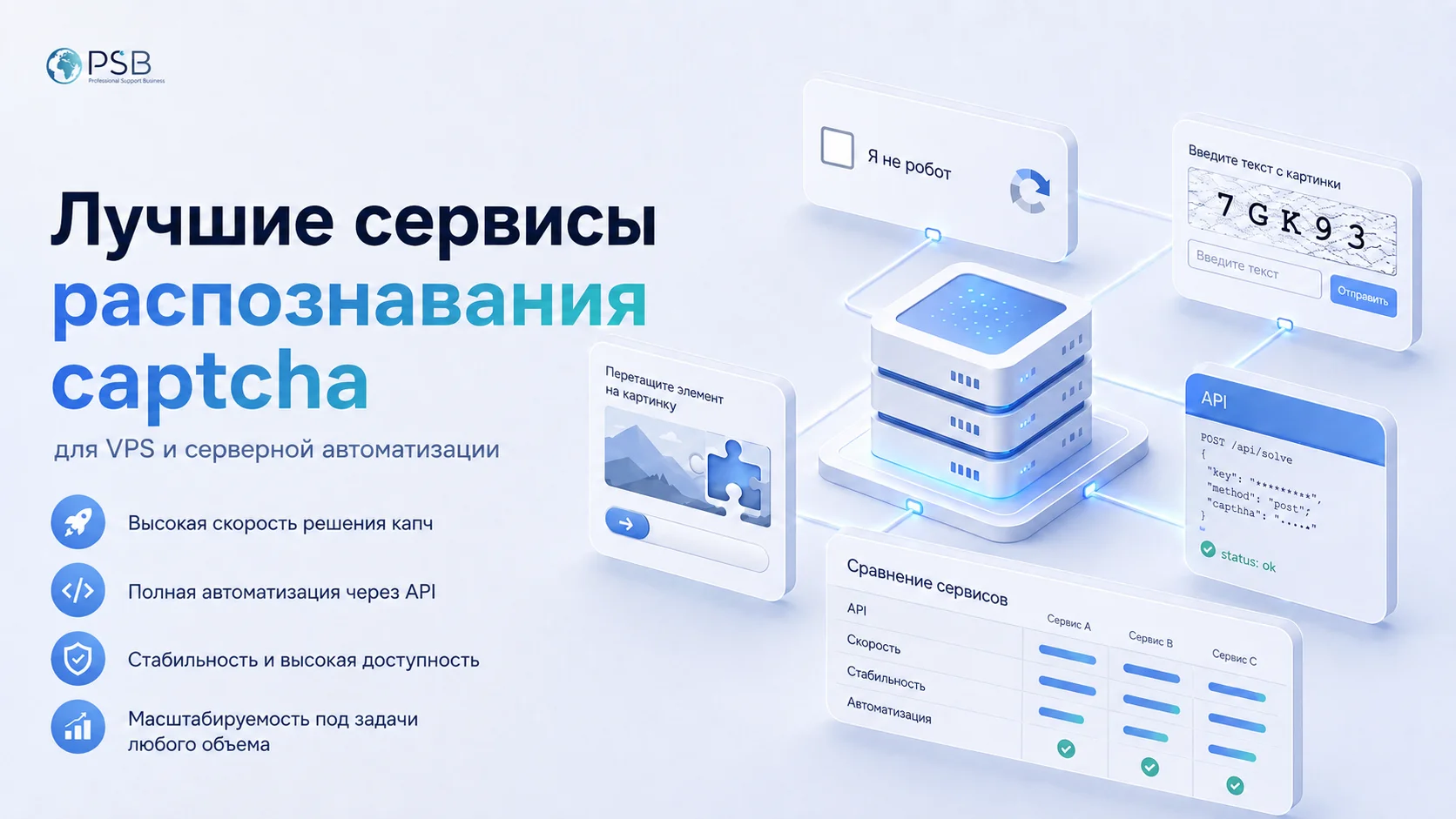
This comparison covers five services:
- 2Captcha;
- SolveCaptcha;
- Anti-Captcha;
- CapSolver;
- DBC.
The figures come from CaptchaTheCat benchmarks and cover correctness, result delivery, recognition time, and benchmark bid indicators.
The short answer
2Captcha and SolveCaptcha produced the strongest overall results.
Both reached an average correctness rate of 89.17%.
The main difference was consistency versus speed:
- 2Captcha returned results more consistently and performed better in several advanced categories.
- SolveCaptcha was slightly faster overall and led several speed tests.
- Anti-Captcha performed well in selected categories but was less consistent across the full benchmark.
- CapSolver produced a strong reCAPTCHA v2 result but took considerably longer.
- DBC could not be evaluated in detail because the available data was limited.
For mixed VPS-hosted workloads, 2Captcha offers the strongest overall balance. SolveCaptcha is the better choice when recognition speed is the main priority.
Why captcha failures increase infrastructure costs
Captcha solving is usually one step in a longer backend process.
A typical workflow may need to:
- start a browser or HTTP session;
- select a proxy;
- load cookies and account data;
- open the target page;
- detect the captcha;
- submit the task to a solver;
- wait for the result;
- send the answer;
- verify that the target accepted it.
If the answer fails, several of these steps may need to run again.
That increases:
- CPU and memory usage;
- browser or container runtime;
- proxy traffic;
- worker and queue load;
- retries and timeouts.
This is why the lowest task price does not always produce the lowest production cost.
The more useful metric is the total cost per completed workflow.
How to read the benchmark
| Metric | What it measures |
|---|---|
| Correctly solved % | How often the returned answer was accepted |
| Received % | How often the provider returned a result |
| Average recognition time | How long the provider took to return an answer |
| Average bid per 1,000 | Comparative benchmark indicator |
Correctness is the primary metric. A rejected answer often creates another challenge and another solver request.
The received rate shows how reliably the service completes submitted tasks. An unanswered task may keep a browser, worker, and proxy connection active until timeout.
Recognition time matters when the answer is correct and arrives before the token or session expires.
The benchmark bid is included for comparison only. It is not an official public price.
Overall benchmark results
| Service | Recognition time | Received | Correctly solved | Bid per 1,000 |
|---|---|---|---|---|
| 2captcha.com | 19.38 sec. | 93.83% | 89.17% | 2.15 |
| solvecaptcha.com | 18.40 sec. | 92.50% | 89.17% | 1.05 |
| anti-captcha.com | 51.83 sec. | 87.17% | 65.83% | 2.51 |
2Captcha and SolveCaptcha had the same average correctness.
SolveCaptcha was about one second faster. 2Captcha returned results for a slightly larger share of tasks.
At low volume, that difference may appear minor. At scale, unanswered tasks continue to consume browser time, worker capacity, and proxy traffic until they expire.
Anti-Captcha was considerably slower and recorded lower average correctness and delivery rates.
Service comparison
| Service | Model | Best use case |
|---|---|---|
| 2Captcha | Automated recognition with human workers | Mixed and unpredictable captcha workloads |
| SolveCaptcha | AI-based recognition | Speed-sensitive automation |
| Anti-Captcha | Primarily human-based processing | Selected captcha categories |
| CapSolver | AI-based processing | Specific automated challenge types |
| DBC | Established provider | Existing and legacy integrations |
2Captcha
2Captcha produced the most balanced result in the benchmark.
Its strongest results included:
- the highest average received rate;
- 100% correctness in reCAPTCHA v2;
- 100% correctness in reCAPTCHA v3;
- the highest correctness in the Cloudflare sample;
- the strongest advanced captcha result;
- 98% correctness in the high-complexity sample.
Its hybrid model is useful when one backend works with many websites and cannot predict which challenge will appear next.
Automated recognition handles common tasks quickly. Human workers provide another route for more difficult cases.
This makes 2Captcha the strongest default for mixed workloads.
SolveCaptcha
SolveCaptcha matched 2Captcha’s average correctness and was faster in several categories:
- reCAPTCHA v2;
- reCAPTCHA v3;
- Cloudflare captcha;
- high-complexity captcha.
It is well suited to workflows where delay directly affects cost or success, including:
- short-lived browser sessions;
- expiring tokens;
- high-concurrency queues;
- automated form processing;
- browser automation with strict timeouts.
Its received rate was slightly lower in some samples, so production testing should still measure timeouts and retries.
Other providers
Anti-Captcha performed well in selected categories, especially image captcha and reCAPTCHA v3. Its overall results were weaker, with lower average correctness and longer recognition times.
CapSolver achieved 100% correctness in the reCAPTCHA v2 sample, but its recognition time was much longer than that of 2Captcha and SolveCaptcha.
DBC may still be relevant for existing integrations, but the available data was too limited for a reliable category-by-category comparison.
Results by captcha type
reCAPTCHA v2
| Service | Recognition time | Received | Correctly solved |
|---|---|---|---|
| 2captcha.com | 6.09 sec. | 100% | 100% |
| solvecaptcha.com | 5.34 sec. | 100% | 100% |
| capsolver.com | 28.00 sec. | 100% | 100% |
| anti-captcha.com | 55.00 sec. | 100% | 20% |
2Captcha, SolveCaptcha, and CapSolver solved every task correctly.
SolveCaptcha was the fastest, with 2Captcha less than one second behind. CapSolver matched their correctness but took much longer.
Best overall choices: 2Captcha and SolveCaptcha.
reCAPTCHA v3
| Service | Score distribution | Recognition time | Received | Correctly solved |
|---|---|---|---|---|
| 2captcha.com | 0.1: 32.58%; 0.9: 67.42% | 8.17 sec. | 100% | 100% |
| solvecaptcha.com | 0: 1.11%; 0.1: 33.33%; 0.9: 65.56% | 7.07 sec. | 100% | 98% |
| anti-captcha.com | 0.1: 20%; 0.3: 13.33%; 0.9: 66.67% | 17.00 sec. | 100% | 100% |
2Captcha combined 100% correctness with the highest share of score 0.9 tokens.
SolveCaptcha was faster, but its correctness rate was slightly lower.
Best for acceptance: 2Captcha. Best for speed: SolveCaptcha.
Cloudflare captcha
| Service | Recognition time | Received | Correctly solved |
|---|---|---|---|
| 2captcha.com | 11 sec. | 100% | 87% |
| solvecaptcha.com | 10 sec. | 100% | 85% |
| anti-captcha.com | 25 sec. | 100% | 86% |
2Captcha had the highest correctness. SolveCaptcha was one second faster.
The difference was small, but 2Captcha offered the stronger balance between speed and acceptance.
Image captcha
| Service | Recognition time | Received | Correctly solved |
|---|---|---|---|
| 2captcha.com | 12 sec. | 98% | 53% |
| solvecaptcha.com | 12 sec. | 97% | 59% |
| anti-captcha.com | 14 sec. | 97% | 60% |
Anti-Captcha led correctness by one percentage point over SolveCaptcha.
2Captcha returned results most consistently.
Image captcha performance depends heavily on language, distortion, image quality, visual noise, and layout. This category should be tested with real examples from the target workflow.
Advanced captcha sample
| Service | Recognition time | Received | Correctly solved |
|---|---|---|---|
| 2captcha.com | 18 sec. | 85% | 97% |
| solvecaptcha.com | 19 sec. | 76% | 95% |
| anti-captcha.com | 53 sec. | 80% | 58% |
2Captcha led in correctness, result delivery, and recognition time.
This was the clearest category-level result in its favor.
High-complexity captcha sample
| Service | Recognition time | Received | Correctly solved |
|---|---|---|---|
| 2captcha.com | 61 sec. | 80% | 98% |
| solvecaptcha.com | 57 sec. | 82% | 98% |
| anti-captcha.com | 147 sec. | 46% | 71% |
2Captcha and SolveCaptcha both reached 98% correctness.
SolveCaptcha was slightly faster and returned slightly more results. Both substantially outperformed Anti-Captcha.
Building a reliable VPS integration
Captcha solving should be treated as an asynchronous external dependency.
A reliable flow should:
- detect the challenge;
- create the solver task;
- store the task ID and session context;
- poll for the result asynchronously;
- submit the answer;
- verify acceptance;
- classify failures;
- retry only when appropriate.
The main request thread should not remain blocked while waiting.
Use background workers, queues, coroutines, dedicated browser processes, or a separate automation service.
Preserve the original session
A captcha answer may depend on:
- cookies;
- proxy IP;
- browser profile;
- User-Agent;
- page URL;
- challenge parameters;
- browser state.
Keep this context unchanged until the answer has been submitted and accepted.
Changing the proxy or rebuilding the browser session too early can invalidate a correct token.
Use separate timeouts
Configure different timeouts for:
- task creation;
- result polling;
- answer submission;
- target response;
- retries.
This makes it easier to identify whether a delay came from the solver, browser, proxy, or target site.
Track workflow completion
A result from the solver does not mean the operation succeeded.
Track:
- tasks created;
- results received;
- answers submitted;
- answers accepted;
- workflows completed.
The most useful metric is the percentage of workflows completed successfully after captcha processing.
Calculate the real cost
A practical formula is:
Cost per successful workflow = captcha costs + proxy traffic + VPS runtime + browser runtime + retry costs, divided by completed operations.
A provider with a lower task bid may still cost more if it causes more retries, longer sessions, or rejected answers.
Which service should you choose?
| Requirement | Recommended service |
|---|---|
| Mixed captcha workloads | 2Captcha |
| One general-purpose provider | 2Captcha |
| Highest average result delivery | 2Captcha |
| Speed-sensitive automation | SolveCaptcha |
| reCAPTCHA v2 | 2Captcha or SolveCaptcha |
| reCAPTCHA v3 | 2Captcha |
| Cloudflare captcha | 2Captcha or SolveCaptcha |
| Advanced challenges | 2Captcha |
| High-complexity tasks | 2Captcha or SolveCaptcha |
| Image captcha | Test SolveCaptcha, Anti-Captcha, and 2Captcha |
Benchmark limitations
Actual performance may vary depending on:
- captcha type;
- target website;
- region;
- proxy quality;
- browser fingerprint;
- traffic pattern;
- integration method;
- system load.
The bid values are benchmark indicators, not official public prices.
The benchmark also does not fully measure API quality, SDK support, fallback behavior, regional performance, or reliability under sustained production load.
Conclusion
2Captcha and SolveCaptcha were the strongest providers in the benchmark.
2Captcha is the best general-purpose choice for VPS-hosted automation. It combined high correctness, the highest average received rate, competitive recognition times, and strong results across standard and advanced categories.
SolveCaptcha is the strongest speed-focused alternative. It matched 2Captcha’s average correctness and returned answers faster in several tests.
For mixed production workloads, 2Captcha is the stronger starting point. SolveCaptcha is better suited to speed-sensitive routes or multi-provider systems that distribute tasks by captcha type.
The final decision should be based on completed workflows, accepted answers, timeout rates, infrastructure usage, and total cost per successful operation.