 March 27, 2026
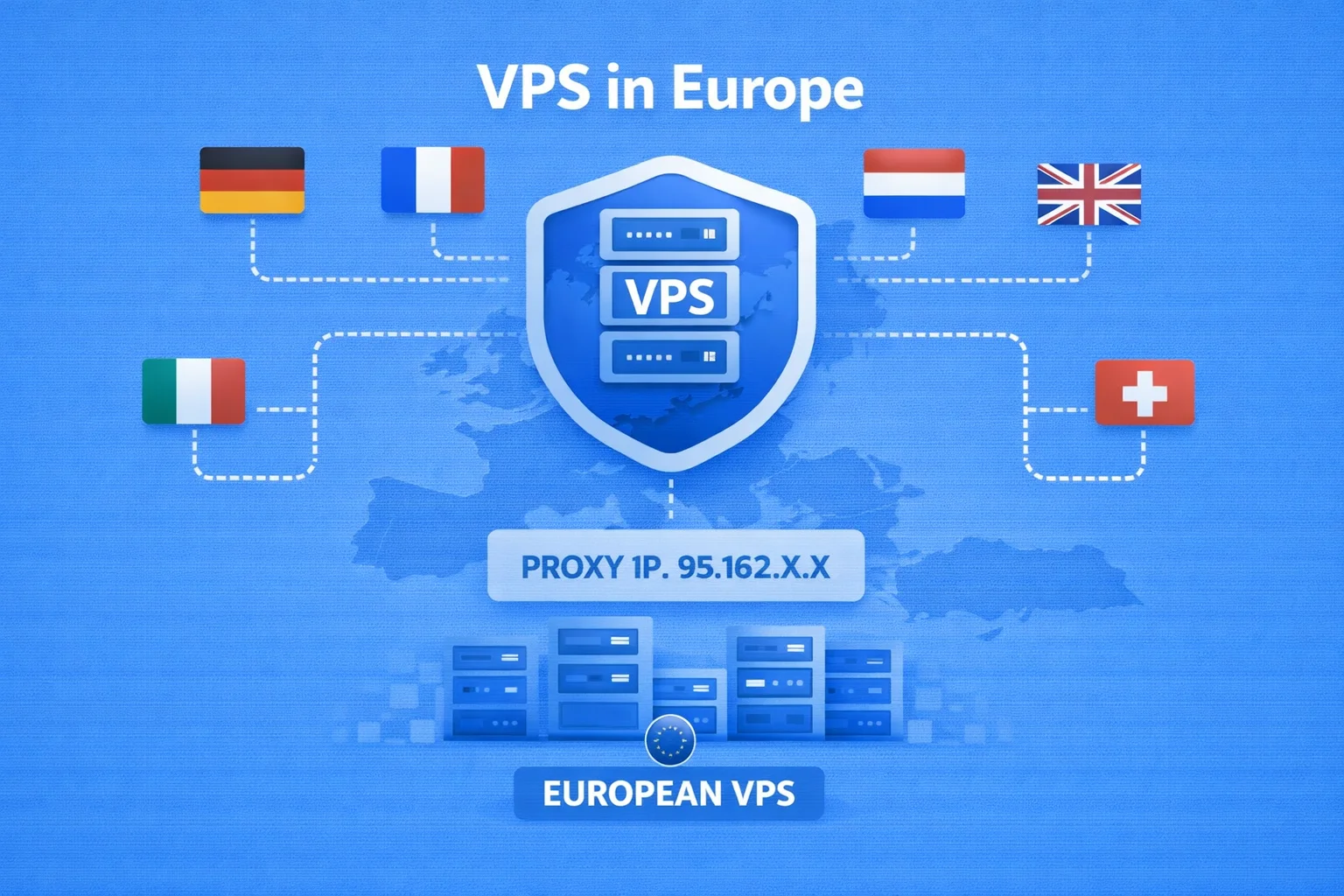
Renting a VPS server in Europe is a popular solution for business and private users. Stable connection, high access speed for European audience and compliance with local data processing regulations make this choice especially attractive. Let's figure out who will benefit from VPS in Europe, how to choose a reliable provider and what parameters to pay attention to when renting.
Why rent a server in Europe
European VPS servers are in demand among a wide variety of users, from owners of small websites to large companies. Let's highlight the main usage scenarios.
For a website or online store
Server location close to the target audience speeds up page loading. If your clients are in Europe, a European VPS will provide low latency and high speed. This directly affects user experience and search engine rankings. Moreover, European data centers strictly comply with data protection laws, for example, GDPR.
When renting a VPS for an online store with payment systems, make sure the provider supports PCI DSS. Additionally, check whether the provider has certificates of compliance with international security standards. This will increase customer trust in your store.
For a bot
Bots often require round-the-clock operation without downtime. VPS provides a stable environment for launch. After all, it does not depend on your computer or home internet. You can set up a task schedule, automate processes and not be afraid that the bot will "crash" due to a failure on the local machine.
If you plan to rent a VPS for a Telegram bot with 10,000+ users, choose a configuration with 2 CPU cores and 4 GB RAM, which will ensure stable operation under peak loads. Do not forget to provide a reserve of resources in case of sudden audience growth to avoid failures in the bot's operation.
For development and testing
Developers value VPS for its flexibility. On a virtual server, it is easy to deploy a test environment similar to production, with the same OS, databases and settings. Thereby, you isolate experiments from the working system, avoid software conflicts and quickly switch between projects. You can also share access with the team. Colleagues connect remotely and work in parallel. For teamwork, access rights differentiation functions are especially useful. They allow you to control who makes what changes to the test environment.
Check with the provider in advance about the possibility of creating snapshots. After all, thanks to this, you can quickly roll back changes in case of an error and save time on restoring the test environment.
For VPN and proxy
If you need a stable and fast VPN or proxy in a European location, VPS is the optimal option. And this is not surprising, because in this case you manage the settings yourself, choose encryption protocols and control traffic. This approach gives more privacy than ready-made services and allows you to bypass geographical restrictions: for example, gain access to European streaming platforms from anywhere in the world.
When planning to rent a VPS for a VPN with 50+ users, take a tariff with bandwidth from 5 Gbit/s and DDoS protection, which will prevent failures under peak load. Pay attention to the possibility of setting up multiple virtual networks (VLAN). This will be useful for separating traffic of different user groups.
How we evaluated: selection methodology
To compile an honest rating, we analyzed dozens of providers according to clear criteria. The main guideline was the balance of price and quality, taking into account the interests of Russian users.
We looked at:
- Data center locations. Priority was given to countries of Western and Central Europe: Germany, the Netherlands, France, Great Britain. Proximity to key internet hubs reduces latency. For audiences from Eastern Europe, VPS in Poland or the Czech Republic is optimal.
- Speed and stability. We checked ping from different regions, uptime and disk performance (IOPS). For high-load projects, look for VPS with uptime of at least 99.9%, which guarantees minimum downtime.
- Technical parameters. We evaluated configuration ranges, starting from minimum tariffs for simple tasks and ending with more powerful solutions for demanding projects. When renting for a CRM system with 1,000 users, choose a configuration with 4 CPU cores and 8 GB RAM. Also consider the disk type. After all, NVMe drives provide 3-5 times higher read/write speed than SATA SSD.
- Payment methods. We took into account the ability to pay in rubles, with Russian cards and electronic wallets. Before renting, check whether the provider accepts MIR cards. After all, not all international hosting services support this payment method. Some providers offer auto-payment, which is convenient for long-term rental.
- Security. We analyzed DDoS protection, backup and privacy policy. For projects with personal data, choose VPS with automatic backup every 12 hours. Check whether the provider uses traffic encryption by default.
- Support. We tested response speed, consultation quality and availability of Russian-language documentation. If you do not know English, rent a VPS from a provider with Russian-language support, which will save hours on solving problems. Assess whether tech support has a 24/7 chat. It allows you to quickly resolve urgent issues.
- Price. We compared tariffs at start and upon renewal, looked for inexpensive options without loss of quality. For long-term rental, it is more profitable to pay for a year. Many providers give a 15–20% discount. Sometimes it is more profitable to take an "all-inclusive" tariff.
- Flexibility. We looked at how easy it is to scale resources, change tariff or add options. If the project is growing, the ability to double RAM in 5 minutes without server reboot is important. We found out whether it is possible to temporarily rent additional resources for the period of peak loads.
Based on these parameters, we selected providers that actually meet customer expectations.
Top VDS/VPS for rent in Europe
1. PSB Hosting
PSB Hosting with servers in Europe that focuses on security and ease of use. Virtual servers (VPS) are located in data centers in Germany and the Netherlands. Clients can choose an operating system. Available options include Linux (Ubuntu, Debian, CentOS), and Windows is provided upon request. Server configurations range from 1 CPU core, 1 GB RAM, 20 GB SSD to 8 cores, 32 GB RAM, 200 GB NVMe. The provider offers unlimited traffic with a connection speed of 1 Gbit/s. As a deployment environment, ISPmanager and VestaCP control panels are available, or a clean operating system without additional software.
Pros:
- fast support in Russian and English;
- automatic installation of popular CMS and scripts;
- DDoS protection at the network level;
- instant activation after payment;
- flexible tariffs, you can choose an inexpensive option to start.
Cons: none.
2. Hetzner
This provider stands out for powerful servers at low prices. Data centers are located in Germany (Nuremberg, Falkenstein) and Finland (Helsinki). Clients choose from a wide range of Linux distributions and Windows Server. Configurations start from 2 cores, 2 GB RAM, 40 GB SATA and go up to 32 cores, 128 GB RAM, 1.9 TB NVMe. Regarding traffic, the provider offers 20 TB per month at 1 Gbit/s speed, and after exhausting the limit — unlimited access at 100 Mbit/s speed.
Services can be paid for using bank cards or via PayPal.
Pros:
- high performance of disks and network;
- among the cheapest tariffs on the market;
- convenient API for automation;
- regular promotions and discounts.
Cons:
- support mainly in English;
- complicated verification for new accounts.
3. OVHcloud
The provider offers a global network of data centers and enterprise-level reliability. Locations include France, Germany, Great Britain and Poland. The OS range includes Linux, Windows and FreeBSD. Configurations start from 1 core, 2 GB RAM, 50 GB SSD and go up to 16 cores, 64 GB RAM, 480 GB SSD. Traffic is unlimited, speed — 1 Gbit/s.
Payment methods are diverse: you can use bank cards, PayPal service or make a bank transfer.
Pros:
- stable operation even under peak loads;
- built-in DDoS protection;
- rich selection of additional services.
Cons:
- starting tariffs are more expensive than analogs;
- control panel interface requires getting used to.
4. DigitalOcean
DigitalOcean is a cloud services provider for developers with a simple interface, API and ready-made images. Data centers are located in Amsterdam, Frankfurt and London. Distributions Ubuntu, Debian, Fedora and others are available. Configurations start from 1 core, 1 GB RAM, 25 GB SSD and go up to 32 cores, 192 GB RAM, 640 GB SSD. Traffic — 1 TB per month, then — $0.01 per GB.
Payment is accepted by cards (Russian ones may not work) and via PayPal.
Pros:
- intuitive control panel;
- extensive knowledge base and guides;
- quick application deployment from templates.
Cons:
- payment restrictions from Russia;
- additional costs for traffic over the limit.
5. FirstVDS
Russian-language hosting with European locations and flexible pricing. Data centers are located in the Netherlands and Germany. Windows and Linux OS are available. Configurations range from 1 core, 1 GB RAM, 30 GB SSD to 8 cores, 16 GB RAM, 150 GB SSD. Traffic — up to 30 TB depending on the tariff.
Payment methods include Russian cards, electronic wallets and bank transfer.
Pros:
- clear pricing policy without hidden fees;
- 24/7 support in Russian;
- possibility of hourly payment.
Cons:
- lower CPU power compared to competitors;
- limited OS selection in starter plans.
6. RuVDS
Russian provider with locations in Europe (Germany, the Netherlands) offers a virtual server with flexible configuration for client tasks. Suitable for rental for VPN, websites and applications. Configurations from 1 core, 1 GB RAM, 20 GB SSD (start) to 16 cores, 64 GB RAM, 500 GB NVMe (premium). Traffic is unlimited at speeds up to 1 Gbit/s.
Payment from Russia is possible with MIR, Visa, Mastercard cards, via YooMoney and QIWI.
Pros:
- Russian-language support 24/7;
- instant server deployment;
- built-in monitoring tools;
- cheap start — tariffs from 299 rubles/month;
- DDoS protection.
Cons:
- no Windows in basic tariffs;
- limited geography of data centers in Europe.
7. Selectel
An international company with data centers in Amsterdam and Frankfurt offers affordable VPS for business and developers. Suitable for hosting websites, launching bots and setting up VPN. Configurations: 1–32 CPU cores, 1–128 GB RAM, 20–2000 GB SSD/NVMe. Traffic — up to 10 TB at 1 Gbit/s speed, then — 100 Mbit/s.
Payment from Russia is possible with cards (including MIR), via YooMoney, QIWI and bank transfer.
Pros:
- high stability and 99.9% uptime;
- API for deployment automation;
- Russian-language support and documentation;
- flexible tariffs, you can choose an affordable plan to start;
- automatic backup (optional);
- integration with cloud services and CDN.
Cons:
- starting price is higher than that of specialized providers;
- access to advanced features requires configuration via API.
8. Hostinger
An international provider with data centers in the Netherlands and Lithuania offers cheap VPS with high performance. Suitable for beginner projects and small VPN solutions. Configurations start from 1 CPU core, 1 GB RAM, 20 GB NVMe and go up to 8 cores, 8 GB RAM, 160 GB NVMe. Traffic is unlimited at 1 Gbit/s speed.
Payment methods include Russian cards (MIR, Visa, Mastercard), PayPal and cryptocurrency.
Pros:
- among the lowest prices on the market;
- intuitive interface;
- built-in hPanel control panel;
- 24/7 support in Russian;
- 30-day money-back period.
Cons:
- limited scaling capabilities;
- no Windows in basic tariffs;
- lower CPU power compared to competitors.
9. IONOS (1&1 IONOS)
A provider with data centers in Germany and Great Britain offers reliable VPS solutions for business. Suitable for renting hosting for VPN and corporate projects. Configurations start from 1 core, 2 GB RAM, 40 GB SSD and go up to 16 cores, 32 GB RAM, 800 GB SSD. Traffic: 50 TB per month at 1 Gbit/s speed.
Payment can be made with Russian cards (with restrictions), PayPal or bank transfer.
Pros:
- high reliability and stability;
- convenient website builder;
- built-in security tools;
- free SSL certificate;
- DDoS protection.
Cons:
- complex control panel for beginners;
- renewal price is higher than starting price;
- payment restrictions from Russia.
10. Kamatera
A cloud provider with locations in Germany, Great Britain and the Netherlands offers a flexible virtual server with instant scaling. Ideal for projects with variable load and VPN solutions. Configurations are customized individually, from 1 core, 1 GB RAM, 20 GB SSD to 32 cores, 128 GB RAM, 2 TB SSD. Traffic: 5 TB per month, then — $0.05 per GB.
Payment methods: Russian cards (restrictions possible), PayPal, bank transfer.
Pros:
- hourly billing;
- instant resource scaling;
- wide selection of OS, including Windows;
- automatic application installation;
- 30-day trial period.
Cons:
- complexity of setup for beginners;
- additional costs for traffic over the limit;
- support mainly in English.
Practical tips before purchasing
To avoid mistakes when choosing a VPS, think through the details in advance. Determine the expected load. For example, for a blog or landing page, a minimum configuration will suffice, while an online store with thousands of products and a bot with hundreds of users will need more RAM and CPU cores.
For projects with seasonal peaks (for example, an online store before holidays), choose a provider with instant scaling, which will allow you to increase resources in 10 minutes without downtime. Check the ping to the data center IP address from your region before renting. If latency is above 50-70 ms, look for a location closer, which will directly affect response speed. Use services like PingPlotter or Speedtest to measure ping to different providers' servers. A difference of 20-30 ms noticeably affects UX.
Clarify the backup policy. Some providers offer backups for free, others for an additional fee. Decide whether you are willing to configure backups manually or prefer an automated solution. Ask whether copies are stored in a separate data center, which protects data during large-scale failures.
Compare service renewal costs. Starting discounts may be attractive, but the price in a year could increase by 2-3 times. Find out the tariff for the second year in advance to avoid unpleasant surprises.
Test support before payment. Ask a couple of questions and evaluate how quickly they respond, what language they communicate in, and how effectively they solve problems. Ask them to demonstrate the recovery process from a backup. This will show the provider's real readiness for emergency situations.
Study the refund policy: many hosting providers offer a trial period of 3 to 14 days. If the service is not suitable, you will be able to get your money back without unnecessary complications. Check the IP address policy. Find out how many IPv4 addresses are included in the tariff and how much an additional one costs. For VPN or proxy services, multiple IP addresses may be needed. IPv6 support will provide opportunities for further scaling.
Evaluate monitoring tools. Convenient dashboards with load graphs, limit exceedance notifications and alerts in Telegram or email save time. It is better to choose a VPS with ready-made integration of such services.
Read reviews about the provider's stability over the last 3-6 months. Pay attention to complaints about downtime, slow support or sudden price increases, which will help form a real picture of the company's work. Look for independent performance tests. They show real disk and network speed, not stated values.
Think about scaling prospects. If the project grows, you will need to increase RAM, CPU cores or disk space. Find out how quickly and conveniently this is done. The ideal option is the ability to scale resources in a couple of clicks without server reboot. Such flexibility will save time and allow you to quickly respond to the growing needs of the project. Clarify the limits in advance. Some providers limit the maximum amount of resources on one account.
Conclusion
Renting a VPS in Europe opens up wide opportunities for hosting web resources, launching automated services and organizing secure connections. A properly selected provider will ensure stable system operation, fast response and compliance with data security requirements.
When choosing, you should consider not only the starting cost, but also the terms of tariff renewal. After all, a sharp price increase in a year can make an initially profitable offer less attractive. It is important to assess the expected load in advance and provide a reserve of resources for project development.
Special attention should be paid to technical parameters — ping to the data center, backup policy and scaling capabilities. Combined with prompt technical support, this guarantees uninterrupted operation of your services in the long term. And do not forget to periodically review the VPS configuration. Optimizing resources for current tasks will help save money without losing performance.