 June 8, 2026
Latency is the delay between a user action and the system response. On a website, it feels like a pause after a click; in an API, like a slow response; in a game, like a delayed reaction. The more important the action, the more latency affects the purchase, integration, or gaming outcome.
What Is Latency in Simple Terms
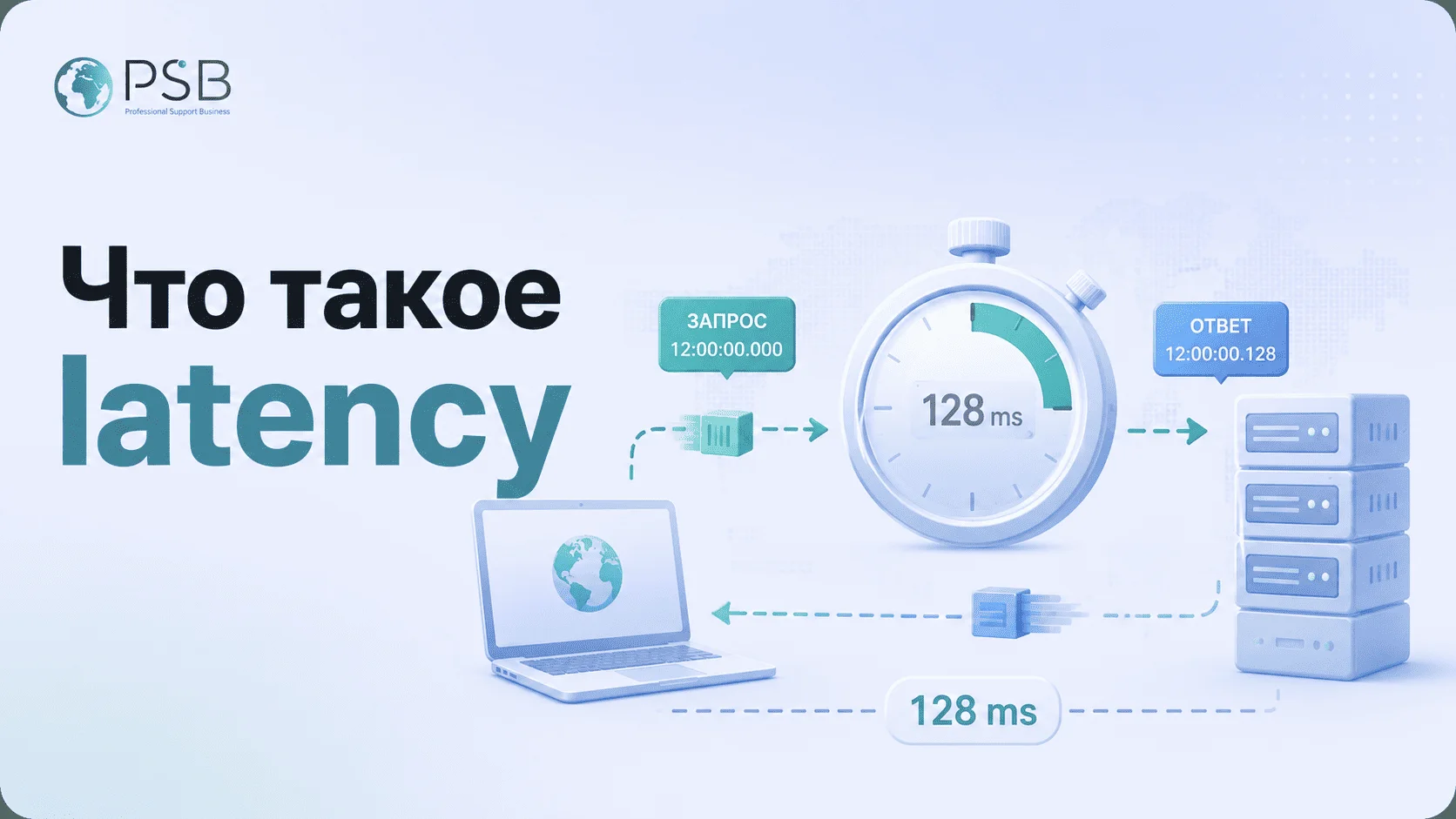
Latency shows how much time passes from request to response. The user clicks a button, the browser sends data, the server processes the request and returns the result. If the pause grows, the service feels slow even with a good network connection.
Network delay is part of total latency. It depends on the distance to the server, the route, channel quality, and load on intermediate nodes. A fast server will not fix the situation if data travels a long or congested path.
How Latency Differs from Bandwidth and Throughput
Network data transfer delay is the time it takes for a request and response to travel between the client, intermediate nodes, and the server. Latency describes waiting for a response. Bandwidth shows channel capacity. Throughput reflects actual data transfer under load.
High connection speed does not guarantee fast response. The channel may be wide, but the first response from the server may arrive late. Therefore, delay time is assessed separately from transfer speed.
What About Ping, RTT, Jitter, and Packet Loss
Ping shows the response time between client and server. RTT is round-trip time, the time it takes for a packet to travel to the server and back. These metrics help quickly understand how close and stable the server responds.
Jitter shows fluctuations in delay between requests. Packet loss means packets are lost, causing actions to arrive late or not reach the server. For games, APIs, and checkout, this is critical.
What Actually Makes Up Latency
Latency consists of network, server processing, database, cache, queues, and external services. The user only sees the final pause. The cause is sought along the entire chain, not in one place.
Sometimes a remote data center is to blame. Sometimes the delay is caused by a heavy SQL query, overloaded database, poor caching, or a payment service. A single ping to the server does not explain the behavior of a store, API, or gaming session.
Network, Distance, and Extra Hops
The farther the server is from the audience, the longer the data path. The request passes through providers, routers, and traffic exchange points. At each segment, a delay appears that affects the overall response.
Extra hops amplify the effect. Data travels through intermediate nodes rather than a short route. During peak hours, this is especially noticeable for users in remote regions.
Server Processing, Database, and External Dependencies
The server also adds latency. The application checks the session, accesses the database, assembles the response, and calls third-party services. If resources are low or the code runs heavy, the request queue grows.
External dependencies often slow down critical operations. These include payments, CRM, delivery, anti-fraud, and third-party APIs. One slow response can slow down the cart, checkout, or personal account loading.
Why Average Latency Does Not Show the Full Picture
The average value hides peaks. Most requests respond quickly, but some hang. In the report, the number looks acceptable, but some users face long waits.
It is better to look at p95 and p99. These metrics show slow requests and rare failures. They reveal problems with checkout, API integrations, game rooms, and peak loads.
How Latency Hits an E-commerce Store
An online store needs speed for key operations. The customer browses the catalog, searches for a product, views a card, adds an item to cart, and proceeds to payment. A delay at any step reduces the chance of an order.
Catalog, Search, and Filters
The catalog must respond quickly. A long pause with filters, sorting, or search reduces trust in the site. The customer expects a fast response to their action.
Product Card, Cart, and Checkout
In the product card, price, stock, delivery terms, description, and recommendations load. If one block responds slowly, the page opens with a delay.
Cart and checkout directly affect payment. If delivery calculation takes a long time, promo code verification pauses, and the transition to payment hangs, the order is lost.
Why Latency for a Store Is Not Just Frontend
For a store, latency is not just frontend, but also backend, database, integrations, and infrastructure.
How Latency Affects APIs
The API works in the background, but latency quickly becomes visible. The site waits for a response, the mobile app hangs, the partner system receives data late. The user notices a slow service, and the team searches for the cause in the logs.
End-to-End Latency and Integration Latency
API Latency is especially important in service chains. One service calls another, the second accesses the database, then goes to an external system. Small pauses add up to a slow response.
End-to-end latency shows the path from the first request to the finished result. It includes network, load balancer, application, database, queue, and external calls. End-to-end latency better reflects real user delay than a single server metric.
Why p95 and p99 Are More Important for APIs Than Averages
Average API latency does not show the full reliability picture. Most requests go through quickly, but some fail under load.
p95 shows the time within which 95% of requests complete. p99 helps find tails related to locks, queues, and external services. These metrics are examined for each endpoint.
Where Latency Becomes a Business Risk
For the customer, the request that breaks payment, authorization, order, or webhook is what matters.
Why Latency Feels Most Acute for Game Servers
In games, delay is perceived immediately. The player presses a key, waits for a reaction, compares action to expectation. Even a small pause ruins the feeling of control.
Ping, RTT, and Game Responsiveness
Ping shows the response time between client and server, not channel speed. RTT affects shooting, movement, item pickup, and hit registration.
Jitter and Packet Loss as Hidden Enemies
Jitter causes response spikes, and packet loss leads to teleportation, rollbacks, and lost actions.
Geography, Regions, and Matchmaking
Geography also matters. A player from Europe needs a server in Europe, a player from the US needs a server in the US. The shorter the path to the server, the faster the response.
How to Measure Latency Correctly
Latency should be measured by user actions and technical metrics. A single ping to the server will not show checkout speed or API performance under load. Data is needed at the network, application, database, and user levels.
- What to look at in an e-commerce store. In a store – first server response, search, product card, cart, checkout, external service errors.
- What to look at in an API. In an API – p50, p95, p99, timeouts, error codes, database time, external calls, queues.
- What to look at in gaming scenarios. In a game – ping by region, RTT by match, jitter, packet loss, tick rate, game event delay.
Metrics must be collected continuously. Problems often appear during peak hours, after a release, or during traffic growth. A one-time test will not reveal such failures.
How to Reduce Latency
First, find the main source of delay. Then change the specific segment: route, region, code, database, cache, or queue. Check the effect with p95, p99, and user actions.
Reduce Distance to the User
Server proximity to the audience reduces network latency. It is important to choose not just a powerful server, but a platform closer to the main users with a predictable network. VPS and dedicated servers can be used for online stores, APIs, game servers, and high-load projects where location, fast disks, sufficient CPU resources, and a stable channel matter. If the audience is in Europe or the US, placing the server in a suitable region helps shorten the request path and reduce response time.
Reduce the Number of Unnecessary Requests and Dependencies
The more calls between services, the higher the total latency. One slow service delays the entire process. Secondary operations are better moved to a queue so they do not delay payment, order, or API response.
Caching frequent responses, combining small requests, queues for background operations, SQL optimization, and external service timeouts help reduce latency. Email, analytics, or secondary synchronization should not delay payment.
Optimize Not Only the Network but Also the Application
The network provides the foundation, but the application also adds waiting. Slow code, weak indexes, and heavy ORM queries increase latency. After releases, look at average response time, p95, and p99.
The Main Point
Latency affects sales, integrations, and games. For a store, the catalog, cart, and checkout are critical. For APIs, the full request path, p95, p99, and timeouts are important. For game servers, ping, RTT, jitter, packet loss, and geography play the main role. Reduce latency where it occurs. When infrastructure, application, and monitoring work together, the service responds faster.