 December 31, 2025
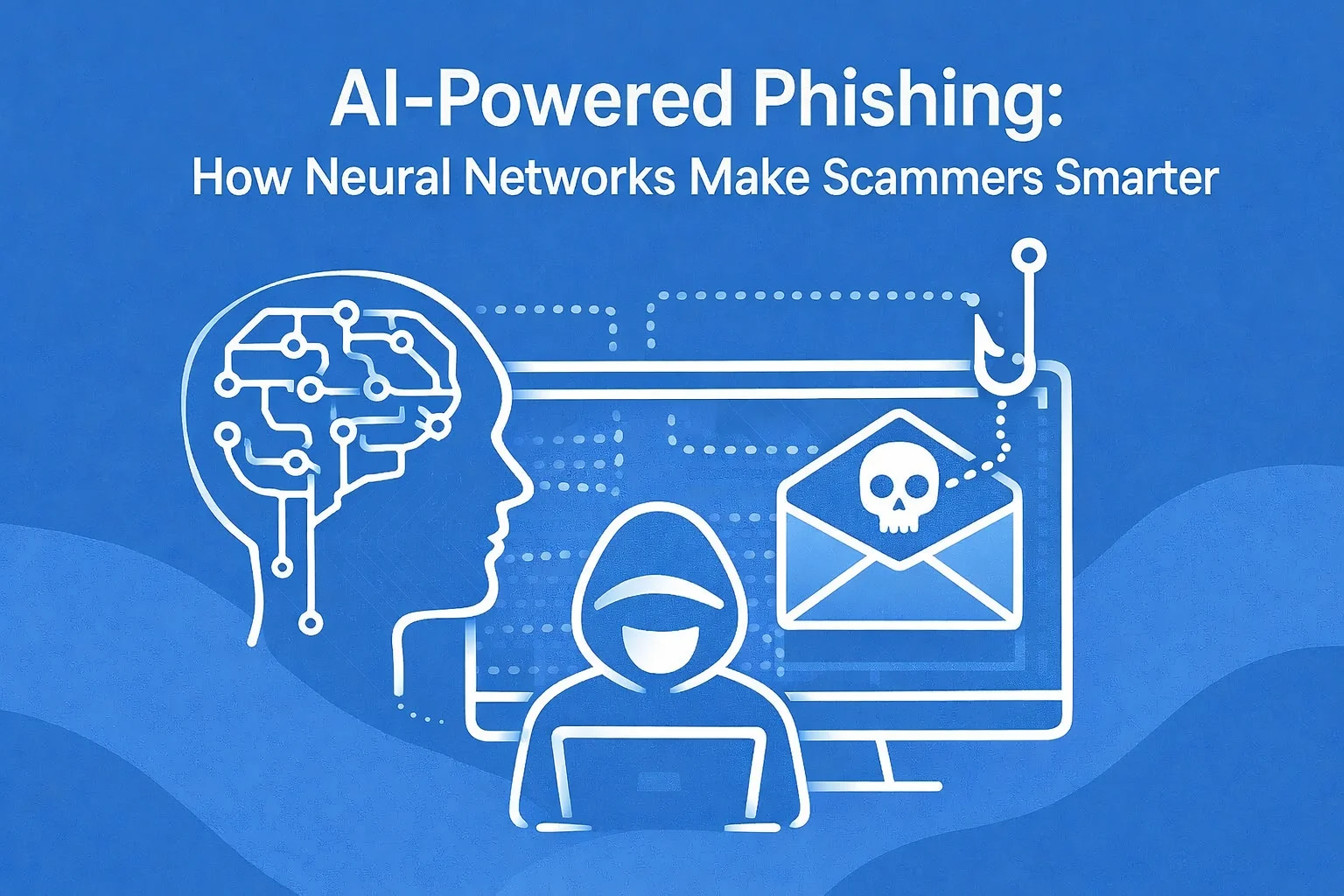
Just a few years ago, phishing attacks looked fairly primitive. Typos, strange sender addresses, generic wording — all of this allowed an attentive person to quickly spot deception. Today, the situation has changed radically. Scammers are actively using artificial intelligence, and as a result, the boundary between fake messages and genuine communication is becoming increasingly blurred.
Modern attacks are no longer based on mass mailings. On the contrary, they are becoming targeted, personalized, and psychologically precise. Messages are written without errors, phone calls sound convincing, and video and voice are nearly indistinguishable from the real thing. With the help of AI, attackers adapt to a specific person — their habits, profession, and level of trust.
The danger lies in the fact that not only inexperienced users are at risk. Increasingly, victims include company employees, executives, accountants, and even IT specialists. In this article, we will examine the tools scammers use today, why we continue to believe them, and how to protect ourselves against next-generation phishing.
The Scammers’ Arsenal: Three AI-Driven Deception Methods
The use of artificial intelligence has taken phishing attacks to an entirely new level. Where manual work and an experienced criminal were once required, now a properly configured algorithm is enough. A neural network analyzes data, mimics communication styles, and scales attacks without loss of quality. Let us look at the main methods in use today.
Next-Generation Text Phishing
Classic phishing was associated with poorly written emails and suspicious links. That is no longer the case. AI-generated texts look logical, persuasive, and fully aligned with the context. Algorithms take into account business correspondence style, industry terminology, and even the individual manner of communication of a specific person.
Such messages may appear to come from banks, colleagues, partners, or support services. They are often based on real events — payments, contracts, deliveries, audits. This is precisely why users do not sense a threat and act automatically, clicking links or sharing data.
Voice Phishing and Speech Cloning
Voice phishing using AI has become one of the most dangerous trends in recent years. Modern models can reproduce a person’s voice from a short recording, preserving intonation, timbre, and characteristic pauses. Studio-quality material is not required — a fragment from a messenger app or social media is sufficient.
As a result, a person hears a familiar voice: a manager, a relative, a colleague. Pressure is applied through urgency and emotion — requests to transfer money, confirm a transaction, or provide immediate help. In such situations, critical thinking shuts down, and trust in the voice becomes decisive.
Video Phishing and Real-Time Deepfakes
Another alarming tool is video deepfakes. Using AI, scammers create fake video calls in which both image and voice appear highly realistic. The technology allows faces, facial expressions, and speech to be altered in near real time.
Such attacks are most often aimed at businesses. An employee sees what appears to be a real manager on the screen and follows their instructions. Despite seeming almost fantastical, such cases are already being documented, and their number is growing. Video communication is no longer a guarantee of authenticity.
Why We Believe Them: The Psychology of Vulnerability to AI Deception
The main paradox of modern phishing is that it works even on people who consider themselves cautious and well informed. The reason lies not in technology itself, but in the characteristics of the human psyche:
- Authority effect. When a message or call looks official, uses correct wording, and refers to real processes, the brain automatically lowers its level of critical evaluation. Where scammers once revealed themselves through mistakes, neural networks now generate texts and scenarios that raise no suspicion.
- Urgency. Victims are deliberately put under time pressure: “this must be resolved immediately,” “otherwise there will be consequences.” Under such conditions, even rational people act impulsively. This is especially effective when a familiar voice or visual contact is involved.
- Personalization factor. Scammers increasingly use AI to analyze open data: social media, data leaks, corporate websites. This allows them to address victims by name, know their position, social circle, and even current tasks. As a result, the interaction feels legitimate rather than like an external attack.
As we can see, AI merely amplifies long-known mechanisms of trust and pressure. In essence, these are the same old schemes criminals have used for years — now enhanced by technology.
The Cost of a Mistake: Consequences and Real Cases
Mistakes when dealing with AI-driven phishing rarely result in a one-time financial loss. The consequences can be far broader and more painful, especially for businesses or when personal data is involved.
A Corporate Case
A typical scenario for a mid-sized company: an employee in the finance department receives a message supposedly from a manager asking to urgently close a payment. The wording is precise, the communication style familiar, and the details align with current tasks. A follow-up call arrives, using a cloned voice.
The transfer is made, and the deception is discovered only later. Losses amount to millions of rubles, and recovering the funds is nearly impossible. In addition to financial damage, the company faces internal investigations, reputational risks, and loss of trust from partners.
A Personal Case
In private life, scenarios are no less convincing. A person receives a call allegedly from a relative or a bank employee. A familiar voice, correct data, and emotional pressure are used. Under the pretext of protecting funds or handling an emergency, the victim is persuaded to share codes, card details, or transfer money.
Even after realizing the deception, many experience severe stress and guilt. This is one reason such crimes often go unreported.
Non-Material Damage
Beyond direct financial losses, there is also non-material harm. Account compromise, personal data leaks, loss of access to services — all of this can lead to long-term consequences. In corporate environments, risks include the leakage of trade secrets and employees’ personal data.
Thus, AI-powered phishing is not a one-off attack but a complex threat affecting finances, reputation, and psychological well-being, ultimately leading to stress and a reduced quality of life.
A Practical Guide: How to Protect Yourself
It is impossible to completely eliminate the risk of AI-driven phishing, but it can be significantly reduced. Protection is based not on complex software or rare technologies, but on established behavioral principles and basic digital hygiene. This is especially important when scammers, empowered by neural networks, act increasingly convincingly.
Principle: Trust, but Verify via an Independent Channel
This is the key rule, and it works better than any instruction. If a request involves money, access, or confidential information, it must be verified through a different communication channel — not the one from which the message or call originated.
For example, if a request comes via a messenger app, call back using a saved number. If it was a video call, confirm the information through corporate email or an internal chat. Even if the voice is familiar and the interlocutor appears convincing, independent verification should become a habit.
Personal Digital Hygiene
On a personal level, protection consists of simple but systematic steps. It is important to limit the amount of information available in open sources. The less data about work, relatives, and daily habits is published on social media, the harder it is for attackers to construct a believable scenario.
Unexpected messages should always be treated critically, even if they seem logical. Any request for urgent action is a reason to be cautious. The simplest response is to pause, think, and consult colleagues, relatives, or friends. A modern neural network can perfectly imitate communication style, but it cannot replace rational judgment and fact-checking.
Corporate Protection
For businesses, the problem of AI phishing requires a systemic approach. Instructions alone are not enough. Processes must be clearly regulated: who can issue financial instructions, under what circumstances, and through which channels.
Training employees using real attack scenarios is becoming best practice. People must understand that even video calls or familiar voices are not absolute proof of authenticity. The earlier this understanding is embedded at the company level, the lower the risk of critical errors.
Will It Get Worse? The Future of AI-Driven Phishing
Unfortunately, the answer is obvious. Phishing will continue to evolve rapidly along with technology. Tools are becoming more accessible, and the barrier to entry for criminals is lowering. Where skills and resources were once required, ready-made solutions and minimal preparation are now enough. Anyone — from a child to a retiree — can engage in such activity.
In the coming years, attacks will become even more personalized and scalable. Automation will allow scammers to interact with thousands of victims simultaneously without sacrificing communication quality. Voice, text, and video will increasingly resemble real sources, erasing the line between fake and original. However, there is also a reverse trend: user and corporate awareness is growing. A new understanding of digital security is gradually forming, where discipline and critical thinking play a central role rather than technology alone.
AI itself is not a threat. It is a tool that can be used for good or for harm. The problem begins when trust replaces verification, and familiar communication models no longer match reality.
Modern scammers act subtly and technologically, using new methods to imitate text, voice, and visual appearance. That is why protection should not start with the search for a “magic solution,” but with rethinking our own reactions and processes.
Awareness, independent verification, and basic digital hygiene remain the most reliable ways to counter next-generation phishing. In a world of rapidly advancing technology, these principles are what allow us to maintain control and security.